
Category — Nursing Careers
Taking a Nursing Career To The Next Level

The popularity of the Master of Science in Nursing program has seen a tremendous spike in the last decade. As more nurses enter the field, that means that just as many eventually choose to pursue a master’s in the field. It’s a logical option, as obtaining the degree allows graduates to pursue positions either in education or management.
Given the hectic schedules that most nurses must already accommodate, an online degree program tends to make the most sense when it comes to fitting in with their lifestyle. Fortunately, the tremendous growth in this program’s popularity ensures that there’s no shortage of online options. Here we’ve ranked the ten best online programs for obtaining a master’s in nursing. All of these institutions are ranked highly by neutral sources, and many have a glowing reputation within the medical community.
1. John Hopkins University
Cost – $33,168 per year
2. Loyola University New Orleans
Cost – $744 per credit
3. Duke University
Cost – $1,358 per credit
4. Drexel University
Cost – $800 per credit
5. Georgetown University
Cost – $21,000-$36,000 per year for full-time studies
6. Clarkson College
Cost – $437 per credit
7. University of Texas-Tyler
Cost – $338.23 per credit for residents; $689 per credit for non-residents
8. University of Colorado Denver
Cost – $355 per credit
9. University of Florida
Cost – $11,954 per year for residents; $29,347 per year for non-residents
10. Delta State University
Cost – $2,862 per semester for residents; $4,548 per semester for non-residents
Source: TOP 10 BEST ONLINE MASTER OF SCIENCE IN NURSING DEGREES
February 26, 2013 No Comments
The 10 Best Online MSN Programs

We were sent a press release today with this ranking of online programs in Master’s of Nursing and thought it was useful enough to publish. According to the site Top Nursing Programs, here are the 10 best online MSN programs.
10. Chamberlain College of Nursing
9. Old Dominion University
8. Drexel University
7. Georgetown University
6. Michigan State University
5. Loyola University New Orleans
4. Benedictine University
3. Indiana State University
2. St. Xavier University
1. George Washington University
The MSN is becoming one of the most important nursing degrees for nurses looking to advance their career. It’s popularity can be clearly seen through the number emails we get from programs and publications contacting us about this particular degree.
June 18, 2012 No Comments
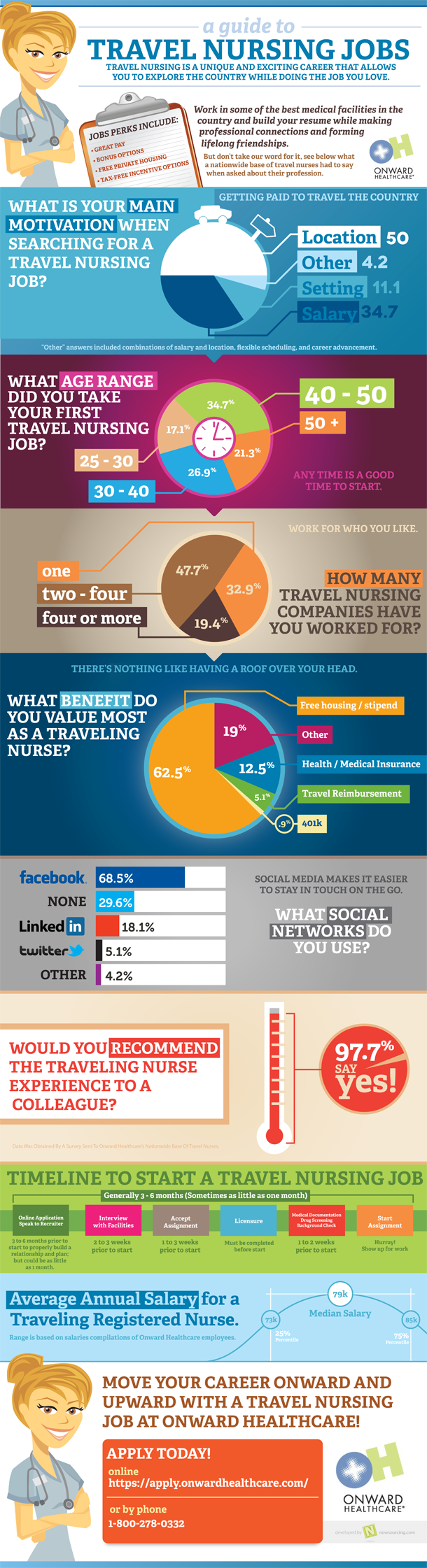
Travel Nursing Jobs [Infographic]
One of the most popular and fastest growing health careers is travel nursing. Traveling nurses get the opportunity to travel around the United States, and experience different cities throughout the year. It is the ideal job for single people who don’t want to be tied down. Many travel nursing jobs also offer lodging stipends which afford you the opportunity to live the high-life everywhere you go. Below we’ve shared with you an infographic on Travel Nursing Careers that we found very useful and we hope that it gives you some insight into whether this is a good career for you.
November 13, 2011 No Comments
Encouraging High School Students To Explore Health Careers
Even in our slowing economy, the greatest demand for jobs is found in the health care industry. Health careers are readily available to those who put the time in to get a proper education. Unfortunately, the supply of health professionals has not bee enough to keep up with demand. So nurses and other health professionals tend get stretched to their full capacity.
The good news is that all over the country there are programs in place to encourage high school students to consider a career in health. Once such program to encourage students is at the North Louisiana Area Health Education Center where students are able to get hands on experience with a health occupation in exchange for high school credit.
February 28, 2009 No Comments
Salaries For Nurses
Nurses continue to be in high demand. A career in nursing is about the best protection you can have against any economic downturn, especially since health is one of the fundamental things that people need.
Over the last decade, salaries for nurses have gone up much faster than most other jobs at about 48% – this growth is not only better than inflation but also better than the majority of other jobs which have either remained steady with inflation or lost ground.
Below, we include the starting salaries and averages salaries for some of the more common nursing positions: [Read more →]
December 22, 2008 No Comments
A Free Medical School and Nursing Graduate Program, Plus More
Did you know there is a school, started in 1972, that offers one of the best educations in the world? It is the F. Edward Hebert School of Medicine and Graduate School of Nursing; which is part of the Uniformed Services University of the Health Sciences in Bethesda, Maryland.
It serves all four branches of the military and Public Health Service. Uniformed students receive their usual pay and benefits. Medical students have a seven year obligation to serve after graduation. Only military nurses are accepted in the post-graduate nursing programs for Master’s degree or PhD completion. Some civilians who are employed by the federal government may be eligible for admission and receive their full salary while attending.
February 16, 2008 No Comments
Five Tips to Ensure Nursing School Success
Guest article by Lara Alspaugh
As an educator, I have seen hundreds of men and women of all ages and backgrounds make a bid for licensure as a Registered Nurse. Some I have watched struggle, others I have watched fly through school with an ease that is envious. While they certainly all had the desire, I believe some of them conducted themselves in a way that was more likely to ensure success. Here are some tips to ensure your success in nursing school.
- Be Professional ~ Where other courses of study may tolerate more flexibility in dress, behavior and professionalism, nursing will not. Nursing has struggled to be regarded as a profession and we take the level of professionalism you bring to the student table very seriously. Abide by the dress code your school subscribes to at all times. Treat your patients, fellow students, professors, and nursing staff at clinical sites with respect. Be on time; both physically and with assigned work. While this may seem an easy tip to follow, many students falter here putting their success in jeopardy.
- Develop a core study group ~ People tend to only remember 10% of what they read, 50% of what they hear and see, 70% of what they say and 90% of what they say and do. By developing a study group that meets regularly and works thru information in a myriad of ways, you will be better prepared. Try taking turns teaching the information to each other, act out the skills you’re being tested on as you talk thru them with your group and support each other. You will be more successful.
- Limit outside obligations ~ I certainly understand, as do most nursing professors, that there simply is no way to avoid all distractions. While many nursing programs suggest you do not work while enrolled, for most students that is simply not a possibility. We all like to eat, have heat and pay our tuition! Balancing work, school and family can be rigorous. Scheduling your time can only be done by you. Do it wisely. [Read more →]
January 30, 2008 No Comments
Consider a Career as a Nurse Practitioner
Guest article by Mari Gold
You’re thinking about becoming a doctor but are put off by the many years of education and the likelihood of emerging in debt; the increasingly high cost of insurance; demanding hours. Maybe you should consider a medical career as a nurse practitioner.
The demand for nurse practitioners is enormous. Nursing in general is one of the ten fastest-growing fields in the U.S, spurred by the increased emphasis on public health, the ageing of the baby boomers and the retirement of existing nurses. Most health care institutions and other settings can’t fill their slots fast enough.
If you think a nurse practitioner is a glorified doctor’s assistant, think again. Today’s nurse practitioners, known as NPs, give complete physical examinations; care for people of all ages; manage chronic conditions like high blood pressure and diabetes; order and interpret X-rays and other lab tests, give immunizations and provide essential patient education. Nurse practitioners can prescribe medication in all states; in 25 states, they are no longer required to practice under the supervision of a doctor.
January 28, 2008 No Comments
Is a Health Career Right for You?
Guest article by Mary Stasiewicz
The health industry is a wide ranging industry with a number of different options for those who are interested in pursuing a health related career. Just selecting a career in this industry can be overwhelming. Besides a number of different types of doctors, other careers in the health industry include nurses, technicians, laboratory employees, dietitians, nutritionists and even personal trainers. This is just a short list of the types of careers available in the health industry. However, before you even begin to narrow down your research to the type of career you wish to pursue and the educational process involved in embarking on this type of career, it is important to determine whether or not you are well suited for a career in the health industry. This article will discuss some of the important considerations you should think about before pursing a health career.
Your motivation for pursing a career in the health industry should be carefully examined. Wanting to help others is certainly a noble cause and a great reason for pursing this type of career but it is not the only worthwhile reason for pursing a career in this industry. If you are motivated by a love of math and science or even if you are drawn to the financial appeal of some careers in the health industry these can also be excellent reasons to investigate these careers. Basically, as long as you have the skills to excel in the career you choose and a dedication to succeed, any logical motivation is acceptable.
January 28, 2008 No Comments